

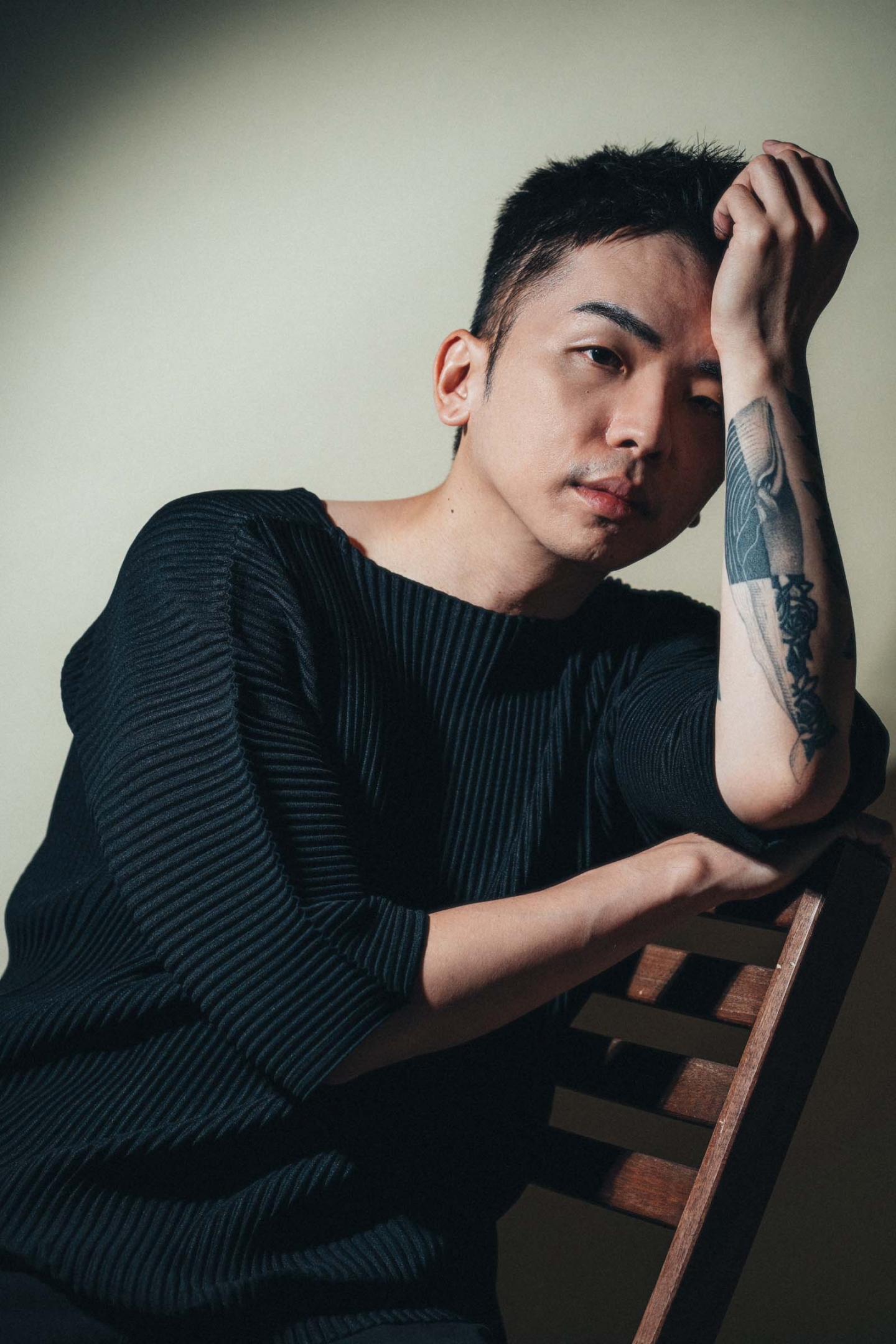
 Photo by Rebecca-ter-Braak
Po-Chien Liu
Po-Chien Liu’s recent work focuses on the reconfiguration of perceptual structures and spatial experience, rather than the mere organization of sonic material. At the core of his practice lies the question of how sound, in states of instability, ambiguity, and continuous transformation, can redefine the relationships between body, space, time, and perception.
The concept of “shadow” serves as a central structural principle in his work. It is neither a visual metaphor nor a symbolic image, but rather a compositional and perceptual model: when sound can no longer be fully located, identified, or named ,when it remains in a state of partial presence and concealment, listening loses its stable object and becomes a continuous process of negotiation, displacement, and reconstruction.
Within this framework, his works explore threshold states between resonance and noise, emergence and disappearance, focus and dispersion. Through these unstable sonic conditions, he creates listening environments in which spatial orientation, directionality, and temporal perception are continuously destabilized and reconfigured.
In recent years, Liu has increasingly extended this approach into interdisciplinary and theatrical contexts. Electronic media, visual elements, and bodily action are no longer treated as supplementary materials, but as integral components of the compositional structure, forming a perceptual dramaturgy centered on sound. His work thus develops toward an expanded performative syntax in which sound is not merely heard, but acts as a generative force between space, movement, and perception.
His works have been presented at major international festivals and institutions including SWR, Gaudeamus Festival, Acht Brücken Festival, Mixtur Festival, and the National Kaohsiung Center for the Arts (Weiwuying), and he has collaborated with leading ensembles and orchestras such as SWR Symphonieorchester, Ensemble Modern, Ensemble Recherche, Ensemble ÉRMA, Ensemble Folkwang Modern, Ensemble Vertixe Sonora, and Thüringer Symphoniker.
His work has received multiple international awards and commissions, including the First Prize at the Acht Brücken Festival Composition Competition (2023), the Second Prize at the Weimar Spring Days International Orchestral Composition Competition (2024), and the Folkwang Prize for Composition (2022), the First Prize at the Asian Composers League Composition Competition (2016). He has also been repeatedly supported by the National Culture and Arts Foundation and other international institutions.
From 2023 to 2024, Liu served as Composer at the Internationale Ensemble Modern Akademie (IEMA), and continues to expand his practice throughout Europe in the fields of instrumental, electronic, music-theatrical, and interdisciplinary composition.
Im Zentrum von Po-Chien Lius künstlerischer Arbeit steht die Rekonfiguration von Wahrnehmungsstrukturen und Raumerfahrung, nicht die bloße Organisation klanglichen Materials. Seine Werke untersuchen, wie Klang in Zuständen von Instabilität, Unschärfe und kontinuierlicher Transformation die Beziehungen zwischen Körper, Raum, Zeit und Wahrnehmung neu definieren kann.
Das Konzept des „Schatten“ bildet dabei ein zentrales strukturelles Prinzip seiner Arbeit. Es fungiert weder als visuelle Metapher noch als symbolisches Bild, sondern als kompositorisches und wahrnehmungsbezogenes Modell: Wenn Klang nicht mehr eindeutig lokalisierbar, identifizierbar oder benennbar ist und sich in einem Zustand partieller Präsenz und Verdeckung befindet, verliert das Hören seinen stabilen Bezugspunkt und wird zu einem fortlaufenden Prozess von Aushandlung, Verschiebung und Rekonstruktion.
Innerhalb dieses Rahmens erforscht Liu Schwellenzustände zwischen Resonanz und Geräusch, Erscheinung und Verschwinden, Fokussierung und Zerstreuung. Aus diesen instabilen Klangbedingungen entstehen Hörsituationen, in denen räumliche Orientierung, Richtungsempfinden und Zeitwahrnehmung fortwährend destabilisiert und neu konfiguriert werden.
Seine künstlerische Praxis erweitert diesen Ansatz zunehmend in interdisziplinäre und theatralische Kontexte. Elektronische Medien, visuelle Elemente und körperliche Aktionen erscheinen dabei nicht als ergänzende Mittel, sondern als integrale Bestandteile der kompositorischen Struktur, aus denen eine auf Klang basierende perzeptive Dramaturgie hervorgeht. Seine Arbeit entwickelt sich dadurch hin zu einer erweiterten performativen Syntax, in der Klang nicht nur hörbar wird, sondern als generative Kraft zwischen Raum, Bewegung und Wahrnehmung wirkt.
Seine Werke wurden bei bedeutenden internationalen Festivals und Institutionen aufgeführt, darunter SWR, Gaudeamus Festival, Acht Brücken Festival, Mixtur Festival sowie im National Kaohsiung Center for the Arts (Weiwuying). Er arbeitete mit renommierten Ensembles und Orchestern wie dem SWR Symphonieorchester, Ensemble Modern, Ensemble Recherche, Ensemble ÉRMA, Ensemble Folkwang Modern, Ensemble Vertixe Sonora sowie den Thüringer Symphonikern zusammen.
Seine Werke wurden mehrfach international ausgezeichnet, darunter mit dem 1. Preis beim Acht Brücken Festival Kompositionswettbewerb (2023), dem 2. Preis beim Weimar Spring Days International Orchestral Composition Competition (2024) , dem Folkwang Preis für Komposition (2022) sowie dem 1. Preis beim Asian Composers League Composition Competition (2016). Darüber hinaus wurde er wiederholt von der National Culture and Arts Foundation sowie weiteren internationalen Institutionen gefördert.
Von 2023 bis 2024 war Liu Composer an der Internationalen Ensemble Modern Akademie (IEMA) und erweitert seine künstlerische Praxis kontinuierlich in Europa im Bereich instrumentaler, elektronischer, musiktheatraler und interdisziplinärer Komposition.
劉博健
劉博健近年來的創作著重於感知結構與空間經驗的重建,而非單純對聲音材料的組織。作品核心關注的是聲音如何在不穩定、模糊與持續變形的狀態中,重新界定人與空間、時間與知覺之間的關係。
「陰影(shadow)」是其創作中的核心結構概念。它並非視覺隱喻,也非象徵性意象,而是一種作曲與感知模型:當聲音無法被完整定位、確認或命名,而始終處於部分顯現、部分遮蔽的狀態時,聆聽便失去穩定的依附對象,轉而成為一種持續協商、游移與重建的感知過程。
在此框架下,其作品探索聲音位於共鳴與噪音、顯現與消逝、聚焦與逸散之間的臨界狀態,並透過這些不穩定的聲響條件,建立一種使空間、方向性與時間感持續被改寫的聆聽場域。
近年來,他逐步將此方法延伸至跨媒介與劇場性實踐。電子聲響、視覺元素與身體行為不再作為附加媒介,而是與器樂聲響共同構成作品的內部結構,形成一種以聲音為核心的感知劇場(perceptual dramaturgy)。其創作因此朝向擴展性的表演語法發展,在其中,聲音不僅被聽見,更作為空間、動作與知覺之間的生成力量而存在。
作品曾於多個國際重要音樂節與機構演出,包括 SWR、Gaudeamus Festival、Acht Brücken Festival、Mixtur Festival、Weiwuying 國家藝術文化中心 等,並與 SWR Symphonieorchester、Ensemble Modern、Ensemble Recherche、Ensemble ÉRMA、Ensemble Folkwang Modern、Ensemble Vertixe Sonora、Thüringer Symphoniker 等國際知名演奏家與團體合作。
其創作曾獲多項國際獎項與委託肯定,包括 Acht Brücken Festival 作曲首獎(2023)、Weimar Spring Days International Orchestral Composition Competition 第二獎(2024)、Folkwang Preis for Composition(2022) 及 Asian Composers League Composition Competition 首獎(2016),並多次獲得國家文化藝術基金會及國際機構支持。2023–2024 年擔任 Internationale Ensemble Modern Akademie(IEMA)Composer,並持續於歐洲拓展其於器樂、電子聲響、音樂劇場與跨媒介創作中的實踐。